A list of buyers, not a database of contacts.
Find your next 10 customers. Not 10,000 contacts.
Competitors left out · they sell what you sell, so they are not buyers
Give us your website. We find real companies that can buy from you, each with a fit score, a sourced reason to call now and the person to ask for.
- Free: up to 5 companies that can buy from you, by email
- No card needed
- You approve every email
- Every email shows where it came from
Already know you want it?Request accessSign in
- companies researched per search, on the biggest plan
- 40
- to try any paid plan, free
- 14 days
- free search every month, for good
- 1
- to see your first companies that fit
- $0
Try it free
Get companies that can buy from you, free.
Give us your website and we'll email you real companies that fit, each with why. We read your site, work out who buys from you, check every claim against what it says, and send the profile with the companies so you can see how we decided.
- Confirm your email: one click, so nobody else can ask in your name.
- A few minutes later: up to 5 real companies that can buy from you, the profile that explains why, and a PDF.
- The rest wait in a free account for this email, open straight away.
The problem
Why do most cold emails go to the wrong companies?
Too broad
“Mid-sized companies in the US”
Lead databases give you thousands of names that match a filter. Almost none of them have your problem right now.
Full of competitors
Half the list sells what you sell
Search “.NET development” and you find other software houses. You pay to research them, then delete them.
No reason to call
“Just checking in” emails
Without a hiring post, a tender or a news item, your first email is about you. That's the one that gets ignored.
Contact databases give you people and leave you to work out who might buy. We give you the companies that fit, with the proof.
Find my customersHow it works
From your website to a list worth calling
Add your website
We read your services and case studies, not just your home page.
Services, case studies, about pages
Approve who you sell to
We describe the companies that buy from you, each claim with the page it came from. Edit it, then approve it.
Every claim with its source
Find companies
Companies hiring or tendering for what you do come first. Sellers are left out before research.
Up to 40 companies researched
Reach out
Draft the first email from the reason to call, and send it from your own mailbox.
You approve every email
See it working
Every company comes with a reason to call, and who to ask for.
Every company your searches find lands on one board, scored against what your best customers look like and explained, ready for you to qualify, reject or export.
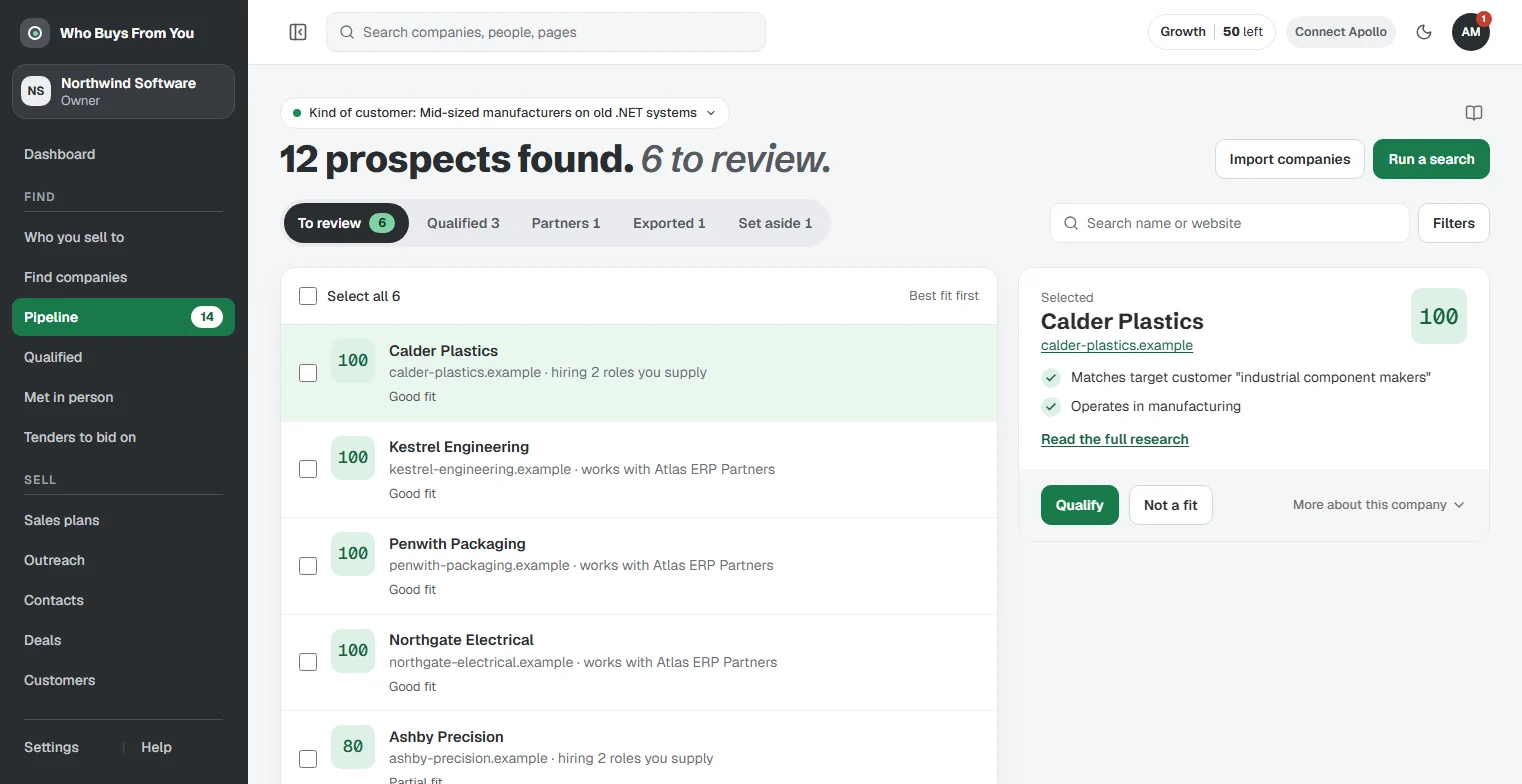
- A fit score for every companyScored against each part of what your best customers look like, with the reason for every point.
- Why contact them nowNews, tenders and job adverts, dated, each with its source.
- Who to ask forThe people with your buyers' titles, and why each is worth approaching.
Shown with example data: the companies and people are made up.
What you get
Everything between “who should we sell to?” and the first email
Every feature is on every plan, Free included.
Who buys from you
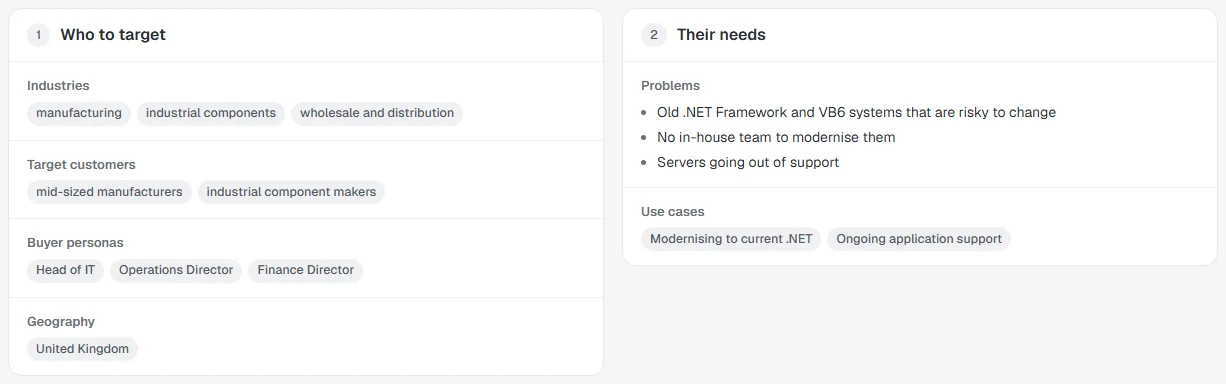
Your best customers, worked out from your own website.
We read your website, services and case studies and describe the companies that buy from you. Every claim links back to the page it came from, and nothing is searched until you approve it.
Find companies
Companies hiring or tendering for what you do, first.
A company advertising for a developer, or asking for bids on new software, needs help today. Searches look for those job adverts and open tenders first, in the words buyers use, not the pages where sellers like you advertise.
Search · 3 kinds of customer tickedExample - Harrowgate Components · .NET developer, contractJob advert
- Brightwater Distribution · ERP replacementOpen tender
- “manufacturers association members”Trade body
Other ways to find them
Official registers, the web in plain words, and local businesses.
Every company of a kind in a place, from its country's official register. Search the web the way you'd say it, like “POS companies in the UK”. Add a company you heard of, even one with no website.
Other ways to find themExample - Manufacturers in Leeds · 214 foundRegister
- “food distributors in Manchester”The web
- Dental clinics in Austin, TexasLocal
Tenders to bid on
Open government tenders for software, read every day.
India's government tenders for custom software, apps, reporting and support, checked once a day without spending a search, matched to who you sell to and judged against your turnover and years in business.
Tenders to bid on · todayExample - Inventory and billing system for a state warehouseYou qualify
- Mobile app for citizen servicesNeeds 5 years in business
Skip list
Competitors kept out, before you pay for them.
A competitor scan, a quick look at every new homepage and your own rejections build a skip list. Say why you reject a company and the next search listens: a competitor or a customer is never offered again.
New companies · checked before researchExample - Harrowgate Components Buyer
- Brightcode Software Competitor
- Top 50 UK software houses (list) Not a company
Past customers
More companies like your best customers.
Upload your case studies, or press Search similar on a customer. We find the competitors of the companies you already work for: the warmest prospects there are, because you have done the job before.
Companies like Kestrel EngineeringExample Kestrel Engineering · your customer
- Ashby PrecisionCompetes with your customer
- Marlow CastingsCompetes with your customer
Every kind of customer
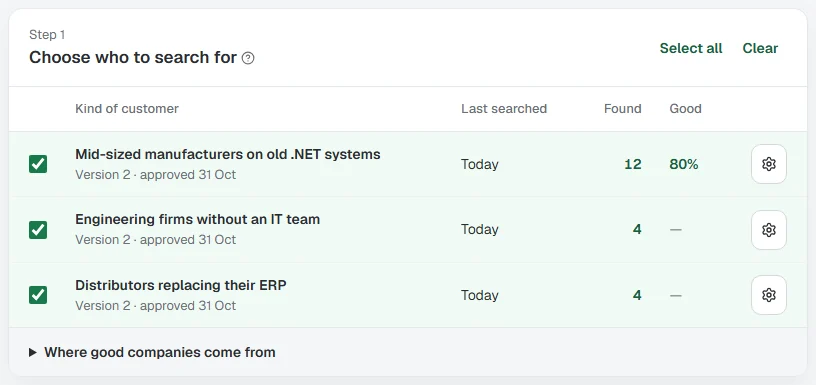
Several kinds of customer, one search, and a scoreboard.
Most firms sell to more than one kind of company. Search them all at once: a scoreboard shows which ones find real buyers, and the next search gives its time to the ones that are working.
Pipeline
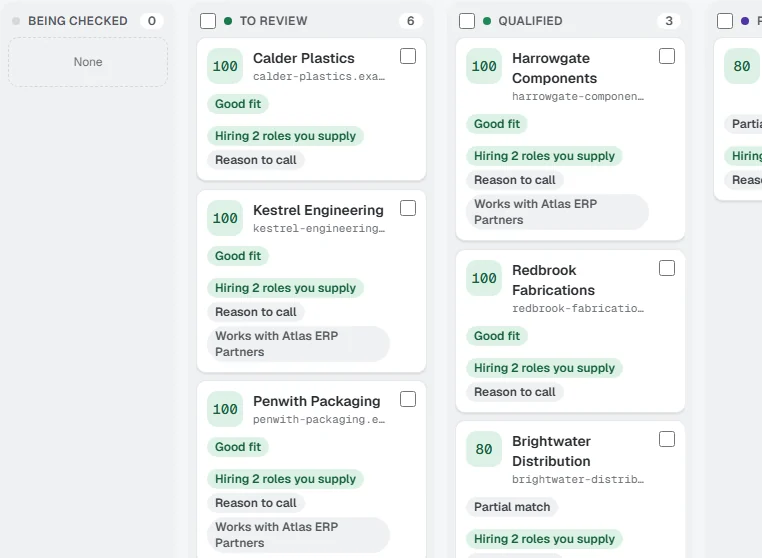
A pipeline you work, not a spreadsheet you scroll.
Every company found lands on a board, scored for fit with the reason for every point. Qualify, reject or mark as a partner, then export the ones you want.
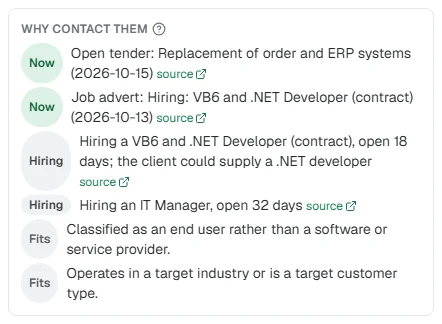
Why contact them
A reason to call now, with the source.
News of an expansion, a takeover or a new leader; public tenders; jobs you could fill; and the agencies they work with today. Dated, linked, next to each company, and watched every week for something new.
People to approach
The right people, with addresses you can trust.
Who to approach at each company, the people who buy first. Names are free; an email or phone comes from your own Apollo or Hunter only when you click for it, and each address can be checked before you send.
People at Harrowgate ComponentsExample - Dana R.Head of IT · decides on buying Valid · from Apollo
- Marcus T.Operations Director · decides on buying Get email Get phone
Contacts
Everyone you could call, in one list.
Every person at every company, whoever on your team found them: email and where it came from, phones, LinkedIn profile and where you are with them. Filter, sort, edit, and download exactly what you see.
Contacts · 48 peopleExample - Dana R. · Head of ITHarrowgate ComponentsProposal sent
- Priya S. · Finance DirectorCalder PlasticsMet in person
- Tom W. · CTOAshby PrecisionDo not contact
Emails with proof
Every first email opens with something you can prove.
A job they posted, news, the technology they run (and when its support ends), or the closest project you've already done. An email with no proof is held until you add one. Two versions of the opening are tried, and the better one kept.
Draft · Harrowgate ComponentsExample “Saw you're hiring a VB6 and .NET developer for your order system. Windows Server 2012 stopped getting fixes in 2023; we moved Kestrel Engineering off the same setup last year…”
Proof: job advertPast project: KestrelVersion B
Outreach
Send from your own mailbox, at the right time.
Gmail, Zoho or Outlook, with your signature and domain checks. Schedule an email for the recipient's morning, see replies in the thread, and work the follow-ups due today. You approve every email; an unsubscribe is honoured on its own.
Follow-ups · Harrowgate ComponentsExample - First email
- Day 3
- Day 7
- Day 14
Day 3 scheduled · Tue 9:10 am, their time
History
Every company's whole story, in one place.
Each search, email, reply, call and note on one timeline. Mention a colleague in a note, and hand over every company one person looks after to another in one go.
History · Calder PlasticsExample - 12 OctFound by a search: a new factory in the news
- 14 OctFirst email sent · Version B
- 17 OctReplied: interested, call next week
- 18 OctNote: @Chris can you join the call?
Met in person
The people you meet at events, kept.
Take a photo of a business card and the details are read for you, even without signal. Send a thank-you the same day, and the company joins your pipeline with the rest.
Met in person · Leeds Tech ExpoExample Business card read
Sam O., Operations Director
Marlow Castings · thank-you due today
Your team, your Apollo
Built for a team, with your Apollo kept private.
Invite colleagues to look and decide. One assigned person searches and spends Apollo or Hunter credits; keys are encrypted and never shown again. Someone new can ask to join instead of starting over.
Access · Northwind SoftwareExample Anna K.Owner · assigned user
Chris L. asked to join
Apollo key · encrypted · never shown again
Ask Claude
Ask about your companies in plain words.
Connect Claude and ask which companies to call this week, or how two of them compare. Claude reads your research and, when you agree, starts a search for you.
Claude · your companiesExample Which qualified companies have a reason to call this week?
Three: Calder Plastics opened a factory, Harrowgate is hiring a .NET developer, and Brightwater's tender closes Friday.
Every email and phone number shows where it came from.
Emails and phone numbers come from your own Apollo or Hunter account, fetched only when you click for them. Each one says where it came from and whether it was checked, so you know which ones to trust. And nothing goes out on its own: you approve every email.
- From your own accountsEmails come from the Apollo or Hunter account you connect; phone numbers only from Apollo.
- Labelled and checkedEach one shows its source next to it, in the app and in your exports, and can be checked before you send.
- None made upNo pattern like first.last@company. Nothing found: we say so.
Who it's for
Built for firms where the founder still sells
IT services firms and software agencies with 2 to 200 people, where the founder still does the selling and there is no full sales team.
- IT services firms
- Software agencies
About us
Finding clients shouldn't take longer than serving them.
For most firms that sell, prospecting means hours in a lead database: running searches, opening company after company, and trying to work out whether each one is a real buyer or just another competitor. Most of that time is wasted, and the first email still goes out with nothing to say.
Who Buys From You replaces that work. We read your website to understand who you serve, search the places buyers actually gather, and filter out competitors and poor fits before you spend a minute on them. What lands in your pipeline is a short list of companies that look like your best customers, each scored for fit, with a dated reason to get in touch and the person to ask for. When you're ready, you write the first email from that reason and send it from your own mailbox.
Pricing
Start free. Upgrade when it's working.
Every plan has every feature. Try any paid plan free for 14 days, with up to 3 searches. Then keep it, or you move back to Free. Prices in US dollars.
Free
Trying it out
$0 forever
up to 5companies researched a month
- 1 search a month of up to 5 companies
- 1 mailbox to send from
Your own website, for as long as you like.
- Every feature included
- No card needed
Apollo on your own account: optional, billed by Apollo
Starter
A founder selling alone
$59 / month
up to 300companies researched a month
- 15 searches a month of up to 20 companies
- 2 mailboxes to send from
One kind of customer, searched about once a week.
- Every feature included
- 14-day free trial, once
Apollo on your own account: optional, billed by Apollo
Growth
A small sales team
$199 / month
up to 1,500companies researched a month
- 50 searches a month of up to 30 companies
- 5 mailboxes to send from
Several kinds of customer, searched a few times a week.
- Every feature included
- 14-day free trial, once
Apollo on your own account: optional, billed by Apollo
Scale
A sales team
$449 / month
up to 5,000companies researched a month
- 125 searches a month of up to 40 companies
- 10 mailboxes to send from
Searching every day, for every kind of customer you sell to.
- Every feature included
- 14-day free trial, once
Apollo on your own account: optional, billed by Apollo
Need more in a month? 5 extra searches for $29.
Apollo runs on your own account.
Our prices cover searches. Apollo is not included: connect your own Apollo account and it is billed by Apollo, on your own credits.
- OptionalNo Apollo? Searches still run on Google and other search engines.
- Your key, encryptedNever shown again: not to your colleagues, not to us.
- One person uses itOnly the person you assign can search with it. Every use is logged.
Questions
Frequently asked questions
How is this different from Apollo or another lead database?
A contact database gives you people and leaves you to work out who might buy. We start from your website and your past customers, decide which companies fit, and find real ones that can buy from you, each with a fit score, a sourced reason to call now and the person to ask for. You can still connect your own Apollo account to find more.
Do you send emails for me?
No. We decide who to contact and why. You approve every email, and send it from your own mailbox, or export the list to the tool you already use.
Where do email addresses and phone numbers come from?
From your own Apollo or Hunter account, when you click to fetch them. Every email and phone number is labelled with where it came from, and any address can be checked before you send, so you know which ones to trust. We never make one up from a name and a company. Phone numbers come only from Apollo.
Who is it for?
IT services firms and software agencies of about 2 to 200 people, where the founder or a small team still does the selling and there is no full sales team.
How do you decide which companies fit?
Before we look for anyone, we read your website and describe the companies that buy from you: who they are, what they struggle with, who inside them decides, and what shows they need you now. Every company we find is checked against it, part by part, and that is where its fit score comes from. Most firms sell to more than one kind of customer, so we usually describe a few kinds and you choose which ones to search for. Nothing is searched until you approve it.
Do I need to know who my best customers are already?
No. Most firms have never written it down. We work it out from your website, services and case studies, show you the evidence for each part, and you edit and approve it. You can also describe a customer in your own words, or start from a company you want to sell to.
Do I need Apollo?
No. Without it, searches use Google, Tavily and other search engines, and free company registers. Connecting your own Apollo account finds more companies, on your Apollo credits.
Who can see my Apollo key?
Nobody. It is encrypted before it is saved and never shown again, not to your colleagues and not to us. Only the one person you assign to search can use it, and every use is logged.
My company already uses Who Buys From You. Can I join it?
Yes. If you try to set up a website that another team already runs, we tell you, and you can ask to join that team instead of starting again. Your request is passed on to them, and their owners decide.
What counts as a search?
One press of Find companies, however many kinds of customer it covers. It researches up to 20, 30 or 40 companies on Starter, Growth or Scale (5 on Free). A search that fails on our side is given back.
Is the Free plan really free?
Yes. The Free plan gives you 1 search a month of up to 5 companies, for as long as you like, with every feature. No card needed.
How do the free trials of paid plans work?
You can try any paid plan free for 14 days, once, with up to 3 searches. At the end, choose the plan to keep it. If you do nothing, you move back to Free. Your results and exports stay yours either way.
Where are prices set?
Plans are monthly, in US dollars. Apollo is not included: it is billed by Apollo, on your own account. You can buy 5 extra searches at any time.
Can I find companies some other way than a search?
Yes. Pick every company of a kind in a place from its country's official register, search the web in plain words, find local businesses on the map, import your own list, or add a company you heard of, even one with no website. Each one is checked and scored the same way.
What makes the first email worth reading?
Every first email opens with something we can prove about the company: a job it posted, news, the technology it runs or when that stops getting fixes, and the closest project you have already done for someone like them. An email with no proof is held until you add one or decide to send it anyway.